Build prompts with hierarchy
Put genre, groove, vocal identity, instrument roles, section contrast, production finish, and ending in a deliberate order.
A complete prompting, songwriting, arrangement, and diagnostic system for creators who want focused AI-music results instead of random generations.
$9.99 Introductory price, plus applicable tax. · Full website library · Downloadable print-ready PDF · Creator tools
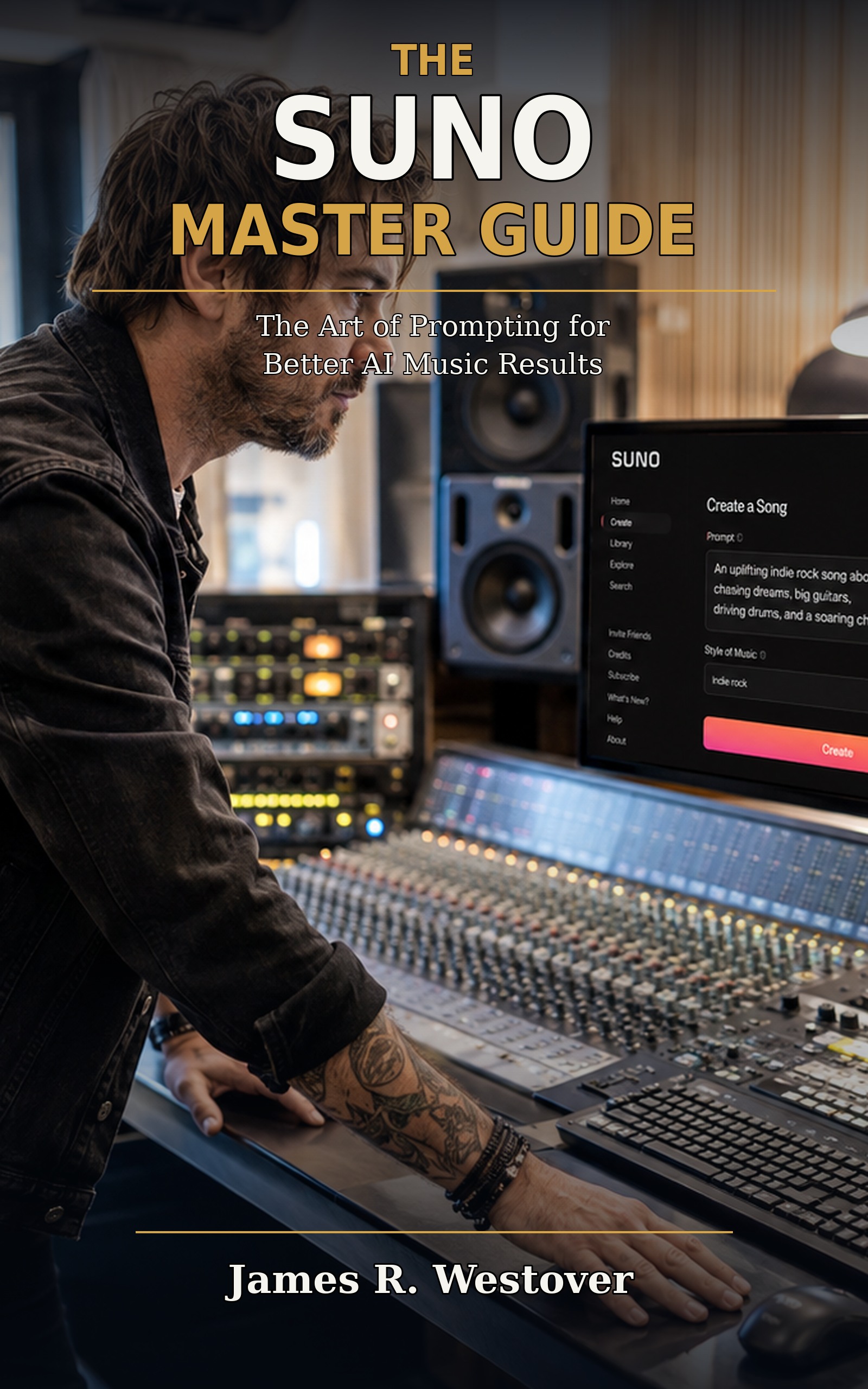
“The objective is to understand why one prompt produces a focused song while another produces a vague imitation of an idea.”
— James R. WestoverThe guide teaches you to translate a musical goal into observable decisions, place each instruction in the correct field, test one variable, and preserve what improved.
Put genre, groove, vocal identity, instrument roles, section contrast, production finish, and ending in a deliberate order.
Control syllable density, prosody, section instructions, hook clarity, point of view, and vocal behavior.
Identify whether the problem comes from vague language, competing instructions, arrangement, vocal direction, or slider balance.
Apply the same logic to hip-hop, pop, rock, metal, country, EDM, jazz, reggae, orchestral, children’s music, and hybrids.
Think through structure, mix priorities, export, metadata, rights, production records, and final release-readiness checks.
Use the searchable web edition, expanded tools, image library, downloadable PDF, and future update modules.
Prompt interpretation, interface field placement, architecture, priority, Style-box engineering, sliders, audio influence, personas, reuse, extend, cover, and remaster.
Lyrics-box engineering, prosody, meter, syllable density, hook science, vocal direction, song structure, energy, instrumentation, and timbre.
Song Editor repair, multitrack Studio workflow, radio-ready arrangement, mix thinking, export, metadata, rights, and release readiness.
Rap, pop, R&B, rock, metal, country, EDM, jazz, blues, reggae, Latin, global, cinematic, orchestral, children’s music, and controlled mashups.
Diagnostic listening, controlled prompt experiments, lyric and vocal repair, arrangement repair, production repair, and one-variable testing.
Prompt formulas, working glossary, sources and update notes, production logs, checklists, and a final production checklist.





These tools run inside the protected member area and are designed around the methods taught in the book.
Assemble a correctly ordered Style prompt, section directions, slider starting points, and a one-variable test plan.
Build a structured first draft from your title, theme, point of view, hook phrase, mood, and selected song form.
Generate multiple hook angles using contrast, repetition, title placement, response lines, and emotional payoff.
Scan a prompt for missing musical identity, overpacked adjectives, absent section movement, and weak endings.
Create A/B/C tests that change one meaningful variable while preserving the rest of the musical brief.
Map intro, verse, pre-chorus, chorus, bridge, breakdown, final lift, and ending against a target runtime.
Access is protected by an individual member code and device limit.
No. It is an independent educational guide. Suno product names, interface labels, and trademarks belong to their respective owners.
Yes. Members can download the complete print-ready PDF from inside the protected library. Web-only interactive tools remain on the website.
No website can guarantee that material visible on a screen will never be copied. This site uses server-side access control, individual access codes, device limits, protected file delivery, no-index directives, and download limits—the controls that actually matter.
The methods focus on prompt hierarchy, songwriting, arrangement, diagnosis, and controlled iteration. Website updates can address interface changes without making the core teaching obsolete.